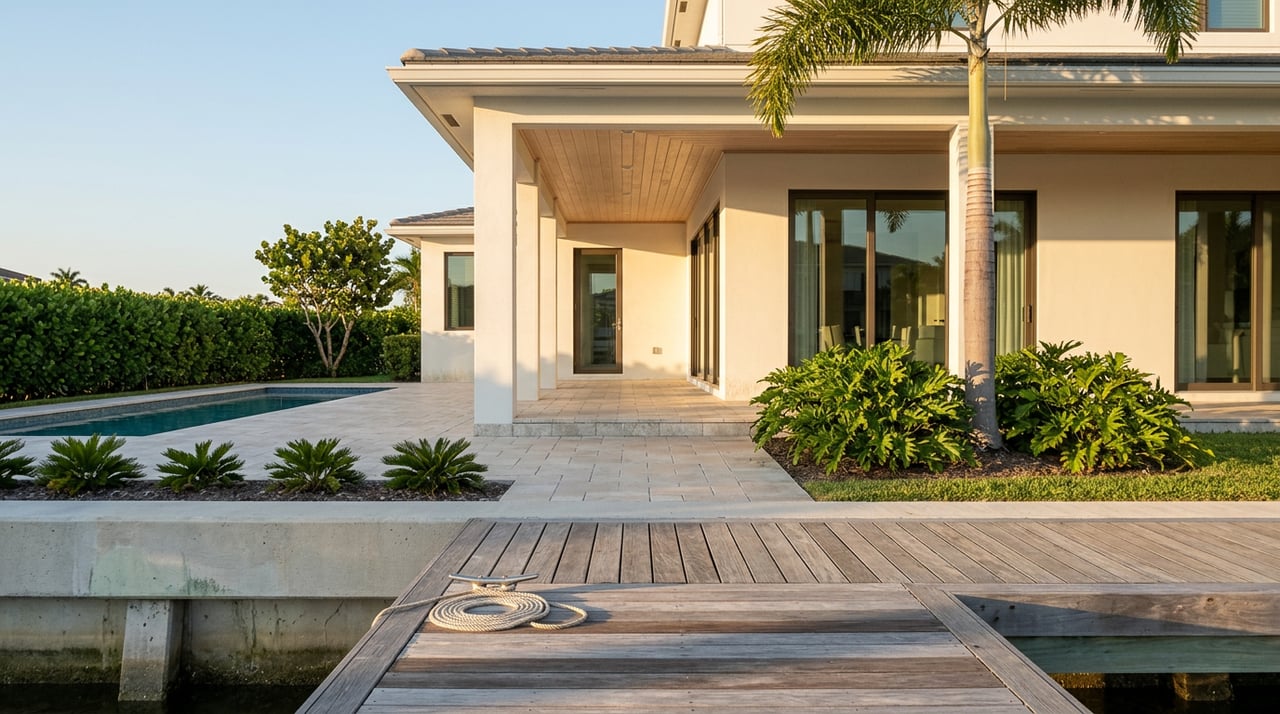
Every listing in Lighthouse Point says some version of the same sentence: no fixed bridges, direct ocean access, minutes to the Atlantic. It shows up on the interior canal homes and the wide-water estates alike, and it's technically true. Lighthouse Point's own residential canals were built without a single fixed span crossing them. That's real, and it's rare in South Florida, where fixed bridges chop up boating routes in Fort Lauderdale neighborhoods like Coral Ridge Isles.
But the sentence stops at the city limit. It describes the canals. It doesn't describe the SR-A1A bascule bridge over Hillsboro Inlet, which lies between the canal mouth and open ocean and which Lighthouse Point does not control and cannot remove. If you're comparing waterfront homes here on the strength of that marketing phrase, you're missing the part of the trip that actually determines whether your boat fits the lifestyle you're buying.
The Promise Every Listing Makes
Walk through a dozen Lighthouse Point listings and the language repeats: 80 feet of dockage, no fixed bridges, direct ocean access. It's shorthand for a genuine structural advantage. More than 80 percent of the city's homes sit on canal frontage or the Intracoastal, and the canal network itself is free of the height restrictions that constrain boat size in parts of neighboring Fort Lauderdale.
What the phrase doesn't say is where the canal ends. The primary route out of Lighthouse Point's canals reaches the Atlantic by passing under the Hillsboro Inlet bridge, the same bascule span that carries State Road A1A over the water just north of the city. That bridge is not fixed. It opens. But it opens on a schedule, and the schedule is the part the marketing skips.
The Bridge That Still Runs the Clock
The SR-A1A bridge at Hillsboro Inlet has a closed vertical clearance of 13 feet. Between 7 a.m. and 6 p.m., it opens on the hour, the quarter hour, the half hour, and the three-quarter hour, a federal schedule set out in the Coast Guard's own regulation for the inlet. Outside that window, it opens on demand.
A 13-foot closed clearance sounds generous until you own a boat with a tower, an outrigger, or a flybridge. Center consoles and most sport boats clear it without a thought. Anything taller waits for the next quarter hour, same as everyone else on the water that day.
That's not a defect in the bridge. It's how a drawbridge on a state highway is supposed to work, balancing car traffic against boat traffic. But it means the phrase "no fixed bridges" describes your canal, not your commute. If you fish offshore in a boat with real air draft, the practical question isn't whether Lighthouse Point has fixed bridges. It's whether you're comfortable timing every outbound and inbound run around a public schedule you don't control.
What the Schedule Costs a Real Boat
For most Lighthouse Point buyers, this is a non-event. A 24-foot center console with the T-top down clears 13 feet without slowing down, and the schedule is a rounding error in a day on the water. The friction shows up for a specific kind of buyer: the one shopping for a sportfisher, a flybridge motoryacht, or anything with a tower built for spotting fish, where clearing 13 feet closed means either lowering equipment that isn't built to lower, or waiting.
Waiting isn't theoretical. If you leave the dock at 7:10 a.m. hoping to make an early bite, you're standing off the inlet until the 7:15 opening, then again coming home. It's a small tax paid every trip, and it's the difference between "direct ocean access" as a lifestyle and "direct ocean access, with a fifteen-minute buffer built into both ends of the day." Buyers who know their vessel's exact air draft before they write an offer are asking a better question than the listing answers.
The Four Numbers Called "The Median"
The bridge isn't the only place where the simple version of the story hides a more complicated one. Ask what the median home price is in Lighthouse Point right now and you'll get a different answer depending on which report you're reading, because each one is measuring something different.
| Reported figure | Time window | What it actually measures |
|---|---|---|
| $1.1 million | Sold homes, month of February 2026 | All homes sold, waterfront and interior lots combined |
| $1,570,000 | Single-family sales, September 2025 | Single-family homes only, waterfront and dry lots combined |
| $1,437,500 | Ocean-access single-family sales, mid-year 2026 | Single-family homes with confirmed boating access to open water |
| $2,790,000 | Waterfront single-family sales, October 2025 | Waterfront-specific inventory, the narrowest and priciest segment |
None of these numbers is wrong. They're answering four different questions. A buyer comparing "the Lighthouse Point median" against a number they saw for Fort Lauderdale or Pompano Beach needs to know which segment they're actually holding, because a $1.1 million all-home median and a $2.79 million waterfront median describe the same city and almost nothing else in common. The spread between the ocean-access figure and the broadest all-sales figure is $337,500 on the same 2.4 square miles of city.
For sellers, this matters at pricing time. A dry-lot interior home and a wide-canal waterfront estate a few streets apart aren't comparable sales, even though both close under the same city name. For buyers, it means the headline number you saw on a portal search is rarely the number that applies to the specific dock you're evaluating.
The Canal Matters More Than the City
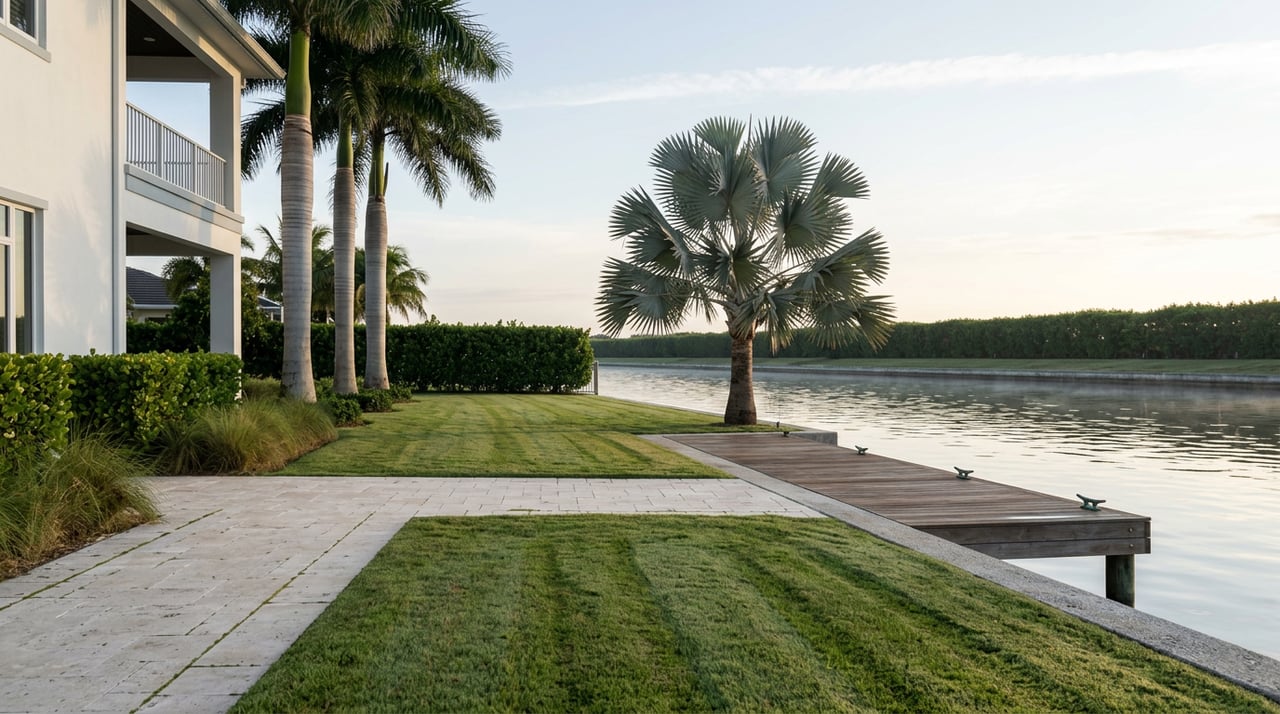
Lighthouse Point treats its canals as infrastructure with rules, not just scenery. The city's dock ordinance uses canal width to govern how far a dock or lift can extend from the seawall. A home on a wide canal near a turning basin can accommodate a larger vessel with room to maneuver. The same size boat on a narrow interior canal a few blocks away may be legally and physically constrained in ways the listing photo never shows.
Depth at the dock, measured at low tide rather than high, is the other variable that separates two otherwise similar-looking waterfront homes. Shoaling moves around near any inlet, and a canal that reads deep on a listing sheet from six months ago may not read the same way today. None of this shows up in a photo of a seawall and a sunset. It shows up when you measure the boat you actually own against the dock you're actually buying, at the tide you're actually going to use it.
What This Changes If You're Comparing Two Docks
If you're cross-shopping Lighthouse Point against Fort Lauderdale or Pompano Beach, or comparing two Lighthouse Point addresses against each other, the useful questions aren't about the city-wide slogan. They're about the specific route:
- What is the vertical air draft of the boat you actually own, and does it clear 13 feet at Hillsboro Inlet without a wait
- Is the canal at this address wide enough for the dock and lift configuration you want
- What's the depth at this dock at low tide, not high tide, and how recently was it sounded
- Which of the four price segments above actually matches the home you're comparing, waterfront or dry lot, single-family or all-property
Landmarks like Cap's Place, reachable only by boat since 1928, or the docks at Port 32 and the Lighthouse Point Marina, are part of what makes the water here feel like infrastructure instead of a backdrop. The Lighthouse Point Yacht & Racquet Club anchors the social side of that same lifestyle. None of it changes the math on your specific canal, your specific bridge clearance, or your specific tide table.
A Few Direct Questions
Does every Lighthouse Point home have true ocean access? No. More than 80 percent of properties have canal frontage or Intracoastal access, which leaves a meaningful share of interior, non-waterfront homes in the mix. Ocean access and waterfront address aren't the same claim.
Is the Hillsboro Inlet bridge the only route to open water? It's the primary route for boats based in Lighthouse Point. Some owners run south to Port Everglades instead, which adds distance and puts you in a working commercial harbor with its own rules.
Does the bridge schedule change seasonally? The published schedule holds through the year, though the Coast Guard and Florida DOT do post temporary changes for repairs or maintenance. Confirming current notices before closing on a boat-dependent purchase is worth the five minutes it takes.
The Takeaway
"No fixed bridges" is an accurate description of Lighthouse Point's canals. It was never a complete description of the trip to the ocean, and the median price you saw quoted somewhere was never describing the specific home you're looking at. Both gaps close the same way: with someone who knows which bridge, which canal, and which segment actually applies to your situation.
If you're weighing a waterfront purchase or sale in Lighthouse Point and want the numbers that apply to your specific dock rather than the city average, The Coastal Realm Group can walk through it with you directly. Schedule Your Free Market Consultation.
This article is general information, not legal, tax or financial advice. Consult a qualified professional about your situation.